|
|

|
|
The first Billingtons came over to America on the Mayflower. Our immediate Billington family came over a century later and we're not sure if we are directly related to the Mayflower Billingtons. The first ones were the sort of rogues you would want to have as ancestors.
The Mayflower Billingtons
John and Ellen Billington and their sons Francis and John were the last
people to board the Mayflower and the first to get off once they arrived in
Massachusetts. Half-way across the Atlantic, 14 year-old Francis Billington
tried to blow up the ship by firing a musket into the powder magazine. This was
not appr eciated. Nor was his father's signature to the Mayflower Compact under
duress. "It's every man for himself," Billington Sr. is reported to
have said. Soon after they landed, his 12 year-old son John Jr. made friends
with Squanto and ran away to join the Indians.
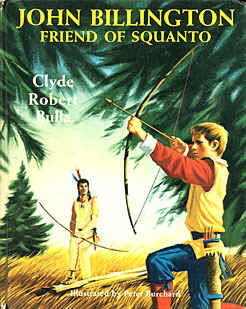 The Indians passed him from village to
village, though, until he ended up with the Pilgrims' enemy, Chief Massasoit.
The Chief decided the Pilgrims should have him back. The Pilgrims in the
meantime had begun to feel guilty about John's absence and were grateful to
retrieve him on Cape Cod. They took the occasion to issue a dinner invitation to
the Indians that Americans now commemorate every November. John Billington Sr.
was executed in 1630, the first person hanged for murder in American history,
and the family disappeared, apart from some court appearances later in the
century in connection with non-marital activity.
The Indians passed him from village to
village, though, until he ended up with the Pilgrims' enemy, Chief Massasoit.
The Chief decided the Pilgrims should have him back. The Pilgrims in the
meantime had begun to feel guilty about John's absence and were grateful to
retrieve him on Cape Cod. They took the occasion to issue a dinner invitation to
the Indians that Americans now commemorate every November. John Billington Sr.
was executed in 1630, the first person hanged for murder in American history,
and the family disappeared, apart from some court appearances later in the
century in connection with non-marital activity.
Our direct descendant's - 18th Century to Present
 Our first direct ancestor was Samuel
Billington, who came over from England in 1756 and settled in upstate New York
around Oriskany. During the Revolution, he served on the local Committee of
Safety and died in the Battle of Oriskany.
Our first direct ancestor was Samuel
Billington, who came over from England in 1756 and settled in upstate New York
around Oriskany. During the Revolution, he served on the local Committee of
Safety and died in the Battle of Oriskany.
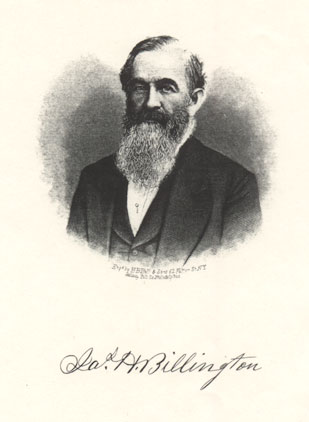
Samuel's grandson, James H. Billington I (left), grew up in the Oriskany area. He married Lovina Perkins there and then moved to Philadelphia in the 1840s to sell blue jeans. He had earlier become involved in politics and had coined the slogan "Free soil, free labor, free minds, and free men," which the Republicans adopted in 1856. He helped bankroll the abolitionist press in Pennsylvania and served on the Philadelphia city council during the Civil War.
His son, David Perkins Billington (below), attended the Pennsylvania Military Academy. During the Civil War, he joined the Union army and fought in the Battle of Fredericksburg.
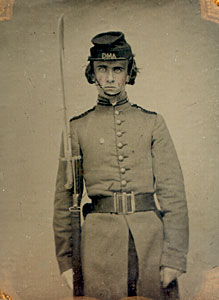
During the war, he wrote an unpublished seventy-chapter novel about a young soldier who distinguished himself in battle, married the general's daughter, and lived happily ever after. In real life, David P. Billington fell in love with a "camp follower," married her, and died in a tuberculosis epidemic in the 1870s.
His son, David P. Billington II, grew up in Philadelphia and married Emma Gilbert. They met at what is now Temple University. He went into insurance and founded a company, Billington and Hutchinson, in Philadelphia.
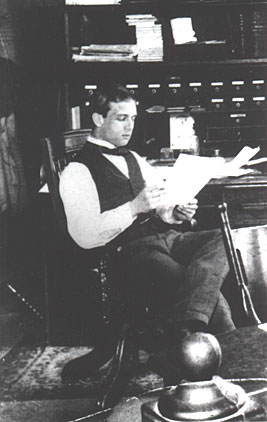
This was after an escapade with his brother-in-law Warren involving the sale of tickets that admitted people to a champagne and flag-bedecked barge in the Delaware River to welcome home Admiral Dewey from the Spanish-American War of 1898. The barge began to take on water and a lot of people in top hats and tailcoats had to scramble to get back on shore.
In 1912 he sold his share in the company and moved to San Mateo, California, where he launched a new insurance business. Unfortunately, he died at age 42 in 1914 . His widow Emma and two children, Nelson and Margaret, moved to Haddonfield, New Jersey..
To be continued...
 ©2001 John Billington and theBillingtons.org about this site |